Tesla has officially dropped FSD v14.3.2, and for those who have been waiting for the "Actually" in Actually Smart Summon (ASS) to really mean something, this is the one. This latest point release isn't just a minor bug fix; it is a fundamental architectural shift that unifies Tesla’s AI models across its Robotaxi, consumer FSD, and Summon platforms for the first time.
Update 2026.2.9.8
Percent of Fleet
Installs on May 10
According to Zack (@BLKMDL3), who has already spent over seven hours testing the new build, the results are "mind-blowing." By moving to a unified stack, the car's behavior in parking lots now mirrors the confidence and smoothness of the unsupervised Robotaxis that have been operating in Austin and recently launched in Dallas and Houston.
Actually Smart Summon: The Robotaxi Treatment
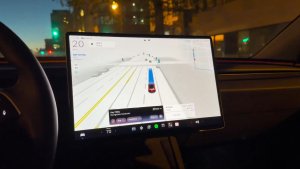
The biggest winner in this update is undoubtedly Actually Smart Summon. Historically, Summon felt like a separate, slower "brain" was trying to navigate the car through a parking lot. With v14.3.2, that silo has been knocked down. "Actually Smart Summon response time on FSD v14.3.2 is instant," Zack noted, sharing footage of the car reacting the moment the button is pressed on the phone.
Actually Smart Summon response time on FSD v14.3.2 is instant. pic.twitter.com/AMRnMHBAUG
— Zack (@BLKMDL3) April 24, 2026
Actually Smart Summon on FSD v14.3.2 pulls over to the curb when it’s done like a Robotaxi does. pic.twitter.com/Fd8BstHEkY
— Zack (@BLKMDL3) April 24, 2026
Because the system is now using the same underlying AI as Tesla’s commercial autonomous fleet, it has inherited some high-end behaviors. Zack observed that the car now pulls over to the curb near the spot you instructed it to come to, just like a Robotaxi would, rather than just stopping awkwardly in the middle of a lane. The system also showed "superhuman" confidence when handling heavy pedestrian and shopping cart traffic, navigating tough scenarios with a level of courtesy that previous versions lacked.
Superhuman Driving and Curvy Roads
FSD v14.3.2 handles curvy roads really well, here it takes me through Mulholland Drive at the top of LA with zero interventions. pic.twitter.com/JXYZhF5XvW
— Zack (@BLKMDL3) April 24, 2026
Beyond the parking lot, FSD v14.3.2 brings a massive amount of polish to street driving. While FSD v14.3 was already a major step forward, this latest iteration feels even more "sentient." During a night drive on the windy roads of Mulholland Drive, the car handled the curves with zero interventions, even spotting and avoiding road debris in the dark before the driver could see it.
FSD v14.3.2 spots road debris and avoids it, mid corner, in the dark and on a windy road. pic.twitter.com/KYYtVfbBTu
— Zack (@BLKMDL3) April 23, 2026
Elon Musk mentioned during the Q1 2026 Earnings Call that Tesla has already achieved "safer than human" driving with the v14 branch. The focus now is on making the system orders of magnitude safer. Version 14.3.2 demonstrates this through its reaction speed — now 20% faster thanks to an AI compiler rewrite introduced in 14.3 — and its ability to handle complex emergencies, like automatically rerouting when a fire truck pulls up to block an accident scene.
The Road to v15 and 10 Billion Parameters
This update serves as a high-performance bridge to the next major milestone: FSD v15. While v14.3.2 is incredibly polished, it still operates on a smaller model compared to what is coming. Musk recently confirmed that FSD v15 will run on current AI4 hardware, ending rumors that the 16GB of memory in current cars wouldn't be enough for the upcoming 10-billion-parameter model.
With v15 expected to debut by the end of this year or early 2027 at the latest, version 14.3.2 represents the "peak" of the current architecture. It also includes a new intervention-reasoning UI that allows drivers to give more personalized feedback after a takeover, helping the Tesla AI team refine the system even faster. As Tesla continues its rapid-fire release cadence, the line between "driver assist" and "fully autonomous" is becoming thinner with every mile.