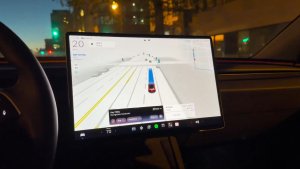
Tesla has officially deployed a new machine learning model designed to improve the accuracy of the displayed wait times for Superchargers. In a recent update shared by the official Tesla Charging account on X detailed how it is drastically improving the accuracy of its in-car Trip Planner forecasts by better predicting driver behavior.
The Mixed-Use Challenge
The core problem Tesla engineers faced was accurately predicting wait times at mixed-use locations. Many Supercharger stations are intentionally co-located with busy amenities such as grocery stores, restaurants, and shopping centers.
When driving to a local Supercharger, many drivers don’t add the location to the vehicle’s navigation system, making it harder for Tesla to predict wait times. In order to provide more accurate wait times, Tesla also needs to consider the vehicle’s location and predict whether it believes it’s headed to a nearby Supercharger.
However, this causes another issue. The system can struggle to distinguish between a Tesla pulling into a plaza to plug in and one pulling in just to grab a coffee. This mixed-purpose traffic made predicting the actual charging queue incredibly difficult and often led to inaccurate wait time estimates.
Training the AI on Trajectory Data
To solve this, Tesla developed a new machine learning model specifically designed to predict a driver's true intent to charge. The model was trained on 9 million miles of aggregated, anonymized vehicle trajectory data collected exclusively within the geofenced areas surrounding global Superchargers.
By analyzing exactly how vehicles physically move, navigate, and park within these specific lots, the system can now accurately distinguish a charging customer from a standard retail shopper based entirely on their trajectory.
The 20% Benchmark
The results of this new model are impressive. According to Tesla, the updated software reduces queue-length estimation errors to about 20 percent.
In real-world terms, this means that even during the busiest holiday travel days, when a station might have a frustrating queue of 10 or more vehicles, the Trip Planner prediction will only be off by a margin of one or two cars. This allows the navigation system to intelligently route drivers to slightly further, but ultimately faster, Supercharger locations to minimize total travel time.
No Update Needed
Since a vehicle fetches Supercharger wait times via Tesla’s APIs, no update is needed to start seeing these changes. Tesla stated that it’s now rolling out this update; however, it’ll likely be limited to certain Supercharger locations as Tesla analyzes the results before rolling it out to everyone.
Preparing for Virtual Queuing
While highly accurate forecasts help drivers plan around congestion, Tesla is also working on a permanent solution to manage the congestion itself. Tesla’s Charging Team is actively piloting a new virtual queue system designed to completely eliminate the physical line at busy Supercharger locations. Tesla has started building out the virtual queue feature in the latest Tesla app.
Instead of navigating a chaotic parking lot and physically waiting in a disorganized line of cars, drivers will soon be able to join a digital waitlist. Whether accessed through the official Tesla app or directly on the vehicle's display, the system will assign users a spot in the queue and provide real-time updates on their position.
Once a charging stall becomes available, the system will direct the driver to their designated spot.
By combining the new trajectory-based AI forecasting with a structured virtual queue, Tesla is actively ensuring that the public charging experience remains as seamless and stress-free as possible, even during peak holiday travel.