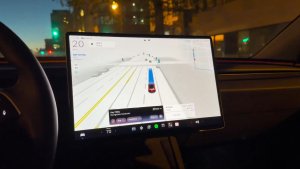
The transition to Tesla's V14 software architecture has been marked by a distinct, undeniable transformation in how the vehicles actually feel on the road. The robotic hesitation and overly cautious braking that defined earlier iterations are largely gone, replaced by a smooth, assertive driving style that feels incredibly natural.
A recent patent titled "Artificial Intelligence Modeling Techniques for Joint Behavior Planning and Forecasting" (US 2026/0105614) reveals how the automaker achieved this behavioral breakthrough. Furthermore, diving into the technical specifics of this patent uncovers the computational magic that will allow these advanced features to run on older Hardware 3 vehicles via the upcoming v14-lite update.
The Problem with Brute Forcing Autonomy

Traditional systems, including older versions of Tesla's own Autopilot and FSD (pre-V12), relied heavily on millions of lines of heuristic C++ code.
When a vehicle approached a busy intersection, the older software attempted a brute force method of survival. It would try to calculate every single possible future trajectory for every moving object on the road simultaneously. The computer would attempt to predict the path of a pedestrian, the speed of an oncoming truck, and the likelihood that a cyclist would swerve, all at the exact same time.
This approach requires substantial processing power and often results in system latency. When a computer is struggling to process a near infinite number of possibilities, the resulting driving behavior is jerky, overly cautious, and distinctly robotic.
The Hierarchical Nodal Graph

Tesla's new patent discusses how it solved this bottleneck by abandoning the brute-force approach entirely. Instead, the company patented a streamlined decision-making architecture based on a "hierarchical nodal graph."
Rather than calculating every possible future, the vehicle's AI builds an efficient decision tree based purely on specific goals and sequential interactions. The system establishes a Goal Node, such as the execution of an unprotected left turn across two lanes of traffic. It then builds Interaction Nodes based only on the relevant agents that actually matter to that specific goal.
Instead of processing the entire intersection at once, the neural net links the relevant nodes sequentially. The plan becomes a fluid chain of logic: yield to the crossing pedestrian, wait for the first oncoming car to pass, and then accelerate behind it.
Thinking Like a Human
The true brilliance of this patent, and the reason V14 feels so remarkably different, lies in how the neural network scores these potential interactions.
The vehicle assigns a specific "Node Score" to each possible action. While physics-based constraints remain the absolute priority to ensure the vehicle does not plot a path that would result in a collision, the system now places greater weight on three new psychological factors.
Comfortability: Will executing this specific maneuver aggressively jerk the passenger or spill their coffee?
Intervention Likelihood: Is this maneuver so unnatural or aggressive that a human driver would panic and grab the steering wheel to disengage the system?
The Human-Like Discriminator: Is this how a real person would actually drive?
The car is literally grading its own potential maneuvers against a massive database of human driving behavior. By actively seeking out the highest score on the human-like discriminator, the vehicle naturally adopts the smooth, assertive flow of an experienced driver rather than the rigid, mathematical exactness of a robot.
Aggressive Pruning and HW3’s Future
Scoring these nodes achieves a massive computational shortcut that the patent refers to as aggressive pruning.
Because the system is grading every possible branch of the decision tree, it can instantly identify bad ideas. If an interaction node receives a low score, perhaps because cutting off a pedestrian triggers a high collision risk and a high likelihood of intervention, the computer instantly deletes that entire branch of possibilities.
It stops calculating the bad idea immediately. The system then aggregates the remaining high-scoring nodes into a final Trajectory Score and seamlessly executes the winning path.
This aggressive pruning mechanism is the hidden key to Tesla's backward compatibility. During the recent 2026 Q1 earnings call, Ashok Elluswamy confirmed that the upcoming v14-Lite update will bring functional feature parity to older HW3 cars, despite executives admitting the older hardware lacks the raw power for Robotaxi operations.
By using this hierarchical nodal graph to instantly remove poor driving options from its active memory, Tesla drastically reduces the overall computational load required to navigate complex urban environments.
This hyper-efficient software optimization is the technological trick that allows the older, less powerful HW3 computers to run the more advanced V14 behavioral logic without buckling under the processing weight.
While the industry fixates on who has the largest supercomputers and the most expensive hardware, this patent proves that Tesla's ultimate advantage lies in its software efficiency. By teaching its cars to think like humans, Tesla has figured out how to do more with significantly less.
If you found this article on how FSD makes decisions interesting, you’ll likely find the rest of our deep-dive patent series on how FSD works a good read. You can find them below:
Tesla’s Universal AI Translator