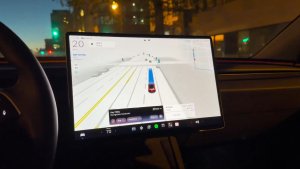
Following the confirmation that Tesla is still working on the rollout of FSD v14 lite for this summer at the Q1 2026 earnings call, Tesla is now addressing the HW3 market and FSD v14 lite outside of North America.
Tesla confirmed plans to expand FSD v14 lite to international markets, some of which have already been approved for FSD on HW4 vehicles, while HW3 vehicles are still waiting.
This means Tesla will pursue FSD approval for HW3 vehicles in these international markets, and they’re just waiting for the additional improvements FSD v14 lite will bring to these vehicles.
Reassuring the Global Fleet
While HW3 lags behind HW4 in North America in terms of FSD capabilities, these owners still have access to the driver-assist system. HW3 owners in countries such as South Korea, China, Australia, and New Zealand saw HW4 vehicles get approved, with no mention of HW3.
While we’ve known Tesla has been planning to release FSD v14 lite for months now, it’s reassuring to hear from Tesla that this software will also be available internationally.
This isn’t just good news for international owners, but for all HW3 owners, as it likely means FSD on HW3 will see a big improvement in capabilities.
While Tesla already stated that unsupervised FSD will not be available on HW3 without an upgrade, it did outline the improvements included in FSD v14 lite. It’s expected to bring all the capabilities of FSD v14 to HW3, including start FSD from park, auto parking at destination and more. While the FSD capabilities between HW3 and HW4 will be the same, we can’t expect FSD on HW3 to handle all the same situations or have the same reaction times as on HW4. Not only will FSD v14 lite be a distilled model, but the cameras on HW3 vehicles are also much lower resolution.
Global Rollout
While the North American rollout for FSD v14 lite is set for late June, Tesla noted in its post that it cannot provide definitive dates for the international expansion at this moment. Bringing advanced autonomous features to new countries is rarely as simple as flipping a switch. In their statement, Tesla outlined three specific factors governing the global timeline: technical verification, regional adaptation, and relevant regulatory approvals.
Regional adaptation can be a complex engineering challenge, as we saw during the international rollout of FSD. Tesla needed to train FSD in each region, adapting to local situations. The system must be rigorously trained to recognize and respond to distinct road markings, unique traffic signs, and localized driving behaviors. Because the cameras differ between HW3 and HW4, these models will need to be retrained for HW3.
Securing regulatory approval in international markets can also be a hurdle; however, it will likely be much easier if the market has already approved FSD for HW4 vehicles. Regulators will simply have to feel that FSD on HW3 is on par with HW4.
Tesla stated it will provide rollout updates on a rolling basis as these individual regional hurdles are cleared. While the wait for FSD on HW3 will be longer for international drivers, Tesla’s messaging is reassuring.