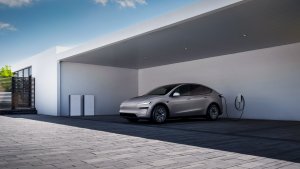
As the first production variants of the Tesla Cybercab begin to roll off the assembly line, fans have noticed a change in the vehicle's color. Rather than using the matte finish seen at the We, Robot event, where the Cybercab was unveiled, the newest production variants feature a unique, glossy finish that’s a part of the plastic panels.
These panels are engineered to strip cost, time, and complexity from the production line.
Decoding the Paint-Free Patent
The secret behind this glossy finish lies in a WIPO patent published by Tesla last year. Filed under WO2025151308 and appropriately titled "System and Method of Manufacturing Paint-Free Vehicle Body Panels," the document outlines how Tesla creates the Cybercab’s exterior panels.
Traditional automotive manufacturing relies heavily on a multi-stage paint shop. This segment of a factory requires substantial physical infrastructure, high energy consumption, and long cycle times to properly apply primer, base coats, and clear coats to stamped metal or raw plastic panels.
Tesla's Cybercab circumvents this entire bottleneck. The documentation details a process in which the color is chemically impregnated directly into the plastic material during the molding phase. By injecting the pigment at the moment the panel is formed under pressure, Tesla successfully achieves a uniform, deep color profile without ever routing the vehicle components through a traditional paint booth.


Achieving the Gloss Finish
Historically, molded-in-color plastics have suffered from dull, matte, or textured finishes that are unsuitable for a premium automotive exterior. Automakers have typically been forced to apply a clear coat to achieve the reflective qualities consumers expect from a new vehicle. Tesla’s patent solves this aesthetic limitation.
The manufacturing method engineered by Tesla simultaneously accomplishes the color impregnation while curing the plastic into a reflective, glossy finish. The result is a plastic body panel that visually mimics the depth and shine of a traditional automotive clear coat, yet keeps a simple manufacturing process, without a separate spraying step.
This integration also means that the gloss is not a thin top layer waiting to be chipped or peeled by road debris, but an inherent, permanent property of the molded panel itself.
If the panel is scratched, it becomes much less noticeable and, in most cases, won’t need to be fixed.
The Economics of Fleet Durability
As a dedicated autonomous vehicle designed specifically for the Tesla Network, the robotaxi will experience exceptionally high utilization rates. Fleet vehicles are subjected to relentless physical wear, parking lot abrasions, and environmental hazards that quickly degrade traditional automotive paint.
Because the color is fully impregnated through the entire depth of the Cybercab's plastic panels, minor scratches and scuffs will not expose a contrasting white or grey primer layer underneath. This material homogeneity improves the durability of the Cybercab.
For fleet operators, maintaining a pristine appearance typically requires body-shop interventions and vehicle downtime. By using glossy, color-impregnated panels, Tesla has a fleet that remains visually appealing with minimal maintenance overhead and easier, cheaper manufacturing.