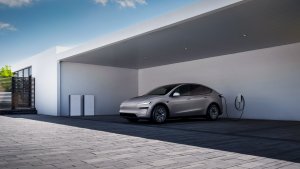
Tesla has officially launched its new virtual queue feature for its Supercharger network. The new dynamic waitlist feature will be piloted at five high-traffic locations in the United States. This feature will allow drivers to join a virtual queue through their vehicle’s software.
Based on Tesla’s video, it looks like your vehicle will automatically join the queue as it approaches the Supercharger location. The driver can then manage the queue, choosing to continue waiting or leave the queue at any time. If the vehicle goes too far outside the Supercharger waitlist geofence, it will automatically leave the queue.
The Virtual Queue will likely also be incorporated into the Supercharger Live Activity on iPhones, letting drivers know how many vehicles are ahead of them, their estimated wait time, and when their turn is up.
While the Virtual Queue feature will be an improvement over physical lines, it won’t prevent all confusion, as some drivers may not be aware of the virtual queue system and may simply try waiting next to the Supercharger and charge their vehicle when a spot opens up. Based on a recent Tesla app we decompiled, it does not appear Tesla will limit charging to the next person in the queue, and anyone would technically be able to pull into the open stall and charge.
We're now testing a new waitlist feature at 5 Supercharger sites. Share feedback through the Tesla app to help us make it better.
— Tesla Charging (@TeslaCharging) May 11, 2026
- Los Gatos, CA - Los Gatos Boulevard
- Mountain View, CA - El Monte Avenue
- San Francisco, CA - Lombard Street
- San Jose, CA - Saratoga Avenue
-… pic.twitter.com/epTVzpJxgW
The New Pilot Locations
The initial rollout targets five locations that typically experience congestion, including four in California and one in New York.
Los Gatos, CA (Los Gatos Boulevard)
Mountain View, CA (El Monte Avenue)
San Francisco, CA (Lombard Street)
San Jose, CA (Saratoga Avenue)
Bronx, NY (East Gun Hill Road)
Tesla is asking drivers who use the feature at these specific stations to provide feedback via the Tesla app to improve the experience. Tesla says it’ll scale this feature if it proves successful.
Solving the Surge
While the goal of the charging team is to eliminate wait times entirely through network expansion and routing vehicles to the least congested Superchargers, unexpected surge events will still occur. Max de Zegher, Senior Director of Charging, recently detailed the engineering philosophy behind the new feature.
De Zegher noted that while larger sites and advanced trip planning algorithms have drastically reduced overall network congestion, physical lines still occasionally form during peak travel periods.
When these surges happen, charging stations can become chaotic as vehicles form a physical line, causing some confusion. In some extreme cases, drivers have even resorted to passing around a clipboard to help organize the queue.
Vertical Integration
While the new dynamic waitlist doesn’t solve congestion, it makes the wait more manageable. Passengers can go inside an establishment, instead of inching forward in their vehicle.
Tesla is leveraging its vertical integration to help solve this problem. Since Tesla owns the app, charging network, vehicle, and the software that ties it all together, it can seamlessly sync a driver's arrival with the exact status of each stall at the charging site.
If the initial feedback from these five pilot locations proves successful, Tesla intends to iterate on the feature and scale the dynamic waitlist across a much larger portion of the global Supercharger network.
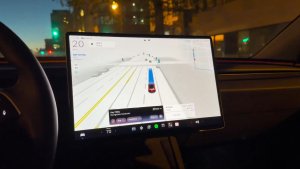
Alongside the recently rolled out AI-powered forecasting and the ongoing rollout of 3D site maps, Tesla has been making many changes to improve the Supercharging experience.