Late last month, the US Patent and Trademark Office granted Tesla another interesting patent focused on vehicle hardware. Titled "Vehicular Seat Suspension System for Belted Seats,” the document outlines a full redesign of the standard scissor-lift suspension seat found in commercial trucking.
Tesla is designing a sliding mechanism that floats on electromagnetic springs to absorb shock and keep drivers and passengers comfortably seated, whether hauling a full load or taking off with cold-gas thrusters.
The Scissor Mechanism
Traditional suspension seats, commonly found in commercial trucks, rely on scissor lift mechanisms to provide vertical travel. The patent notes that these legacy designs suffer from several flaws, primarily poor lateral stability and high deflection rates during crash testing.
Tesla's solution removes the scissor lift. Instead, the patent details a sliding mechanism where a moving inner element slides vertically within a static outer element mounted directly to the vehicle floor.

To pass the stringent Federal Motor Vehicle Safety Standards for heavy loads, the design features heavy-duty crash interlocks. A T-shaped member and a C-shaped feature actively engage during high fore and aft forces. This interlocking system effectively acts as an emergency braking mechanism, preventing the moving seat from breaking apart during a severe collision.
Most modern trucks have also moved away from these scissor lifts, relying on an air suspension system for the seat that allows it to absorb more bumps and vibrations than traditional seats.
Integrated Seat Belts
Traditionally, seat belts have been anchored to the cab wall while the seat bounces independently.
This creates uncomfortable relative motion between the restraint and the driver. These Tesla seats have the seatbelt retractor built directly into the moving inner element of the seat, as in most cabs nowadays. When the seat moves vertically, the seatbelt moves perfectly in tandem with the driver's shoulder.
Electromagnetic Springs
The vertical displacement itself is managed by a spring system. While the patent notes that it could use a pneumatic air spring controlled by an electronic valve block, it also highlights the potential use of an electromagnetic suspension system to instantly counteract road forces.
Also for Roadster?
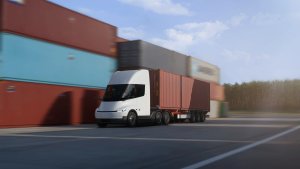
While the heavy-duty crash interlocks and integrated belts clearly point to the Tesla Semi as the primary target, the upcoming Roadster is the perfect candidate for this technology.
A hypercar capable of record-breaking acceleration requires complete stability to keep the driver secure and focused. When equipped with SpaceX cold-gas thrusters, the next-generation Roadster will likely generate multi-directional G-forces during acceleration, extreme cornering, and heavy braking.
Traditional fixed sports seats would transfer all that violent kinetic energy directly to the occupant. However, an electromagnetic sliding suspension seat could actively counteract those forces in real time.
By keeping the seatbelt retractor directly synced with the driver's shoulder and using electromagnets to absorb the shock of thruster-assisted maneuvers, Tesla can provide a unique comfort experience in a racecar like no other.