Tesla is pushing ahead with its ambitious plans for an autonomous future, and that means putting its purpose-built Cybercab through the ultimate test: real-world public roads. However, as more of these vehicles hit the streets, they are bound to encounter the unpredictability of human drivers. Recently, what appears to be the first recorded accident involving a Tesla Cybercab surfaced online, though it doesn’t look like the robotaxi was the one at fault.
The incident was shared on social media by user @bigcolll, who posted an image of a champagne gold Cybercab in what looks like a multi-car pileup. From the photo, it appears the Cybercab was rear-ended by the car behind it, pushing the robotaxi into the car in front of it. The Tesla community was quick to quip about how the majority of Cybercab accidents will likely be caused by human drivers running into these robotaxis from behind. This aligns with data from other autonomous fleets like Waymo, where rear-end collisions by distracted human drivers remain a primary cause of incidents.
Mass Production at Giga Texas
The sighting of this Cybercab in the wild is no surprise, given that Tesla officially kicked off mass production of the vehicle at Gigafactory Texas last month. Unlike the matte-finished prototypes we’ve been seeing since the Cybercab was unveiled back in 2024, the production units currently rolling off the line feature unique glossy body panels.

Tesla is currently producing a mix of Cybercab units, including those without steering wheels or pedals. While the company has a "Plan B" to add traditional controls if required by law, the ultimate goal is a fleet of fully autonomous vehicles that require zero human intervention. Seeing entire fleets of these vehicles staged at Giga Texas suggests that the scale of the rollout is increasing rapidly.
Expanding the Unsupervised Network
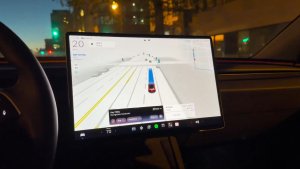
This accident comes just as Tesla is aggressively expanding its Robotaxi service. Last month, the company launched fully unsupervised rides in Dallas and Houston, marking a major milestone for the network. Unlike the service in the Bay Area, which still utilizes safety drivers, these Texas markets are operating with truly empty front seats.

The Cybercab is designed to be the backbone of this network, offering a more cost-effective and specialized vehicle for ride-hailing than the Model Y. While regulatory data shows that robotaxis are rapidly approaching human-driver parity for safety, minor "fender benders" like this one highlight the growing pains of mixing AI with human-driven traffic.
As Tesla ramps up production to hundreds and thousands of Cybercabs per week, we can expect to see more of these vehicles in cities across the U.S. While a crash is never ideal, the fact that the first Cybercab accident appears to be a standard rear-end incident by a human driver might actually bolster Tesla's argument that its AI is the safer operator on the road.