One of the most persistent criticisms of Tesla’s reliance on camera-only autonomy has been its performance in extreme weather conditions.
Critics often argue that radar, LiDAR, and ultrasonic sensors (USS) can help a vehicle navigate challenging conditions, but Tesla has been adamant that Tesla Vision performs better than multiple sensors.
So how does a vehicle lacking additional sensors see through heavy rain, blinding fog, or thick snow? Just this month, Tesla published a patent titled "Fail-Safe Corrective Actions Based on Vision Information for Autonomous Vehicles," which outlines how FSD reacts to weather.
Tesla Vision doesn’t simply shut down or freeze when the weather turns poor. Instead, it actively diagnoses the types of visual obstructions seen and then uses countermeasures to maintain safe operation.
Visibility Grid and Scene Tags
To understand how FSD handles bad weather, it is necessary to examine how the neural networks interpret a compromised camera feed. As the vehicle drives, the neural networks continuously ingest images from the surrounding cameras at rapid frame rates, such as 30 Hz (HW3) or 60 Hz (AI4).
When a camera's view is blocked, FSD does not just register a generic error and give up. The neural network actively divides the incoming images into a grid consisting of rectangular pixel areas. The system then evaluates each individual portion of that grid and assigns it a specific visibility value.
That scale goes from 0 to 3, with a perfectly clear image receiving a 0 and a completely occluded image receiving a 3.
Once FSD maps the severity of the obstruction using this grid, it goes a step further by identifying the exact culprit. The patent reveals that the neural network assigns specific "scene tags" to the occluded areas.
The software is trained to differentiate between a massive variety of environmental hazards. It can tag a scene with labels for haze, condensation, ice, water, rain, sun glare, fog, smoke, and tire spray. The system is sensitive enough to detect a dirty windshield or a hardware fault, such as dead pixels.
Active Hardware Countermeasures
The most impressive aspect of this patent is how the vehicle responds to these scene tags. Tesla has integrated the visibility neural network into the vehicle's hardware. When the software detects a high visibility value paired with a specific scene tag, it triggers automated, fail-safe corrective actions.
If the system tags a scene as rainy, it can automatically activate the windshield wipers, while other poor-visibility tags can trigger the headlights or hazard lights.

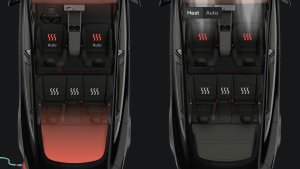
On the other hand, if the neural network detects "snow" or "condensation," it can command the vehicle to activate the windshield heaters or air-conditioning defoggers to clear the glass.
The neural networks can also actively change lanes to avoid road hazards, such as moving over to escape heavy tire spray from a leading truck. Of all the features discussed in the patent so far, this appears to be the only one that Tesla has not implemented in FSD today.
Finally, to ensure the driver is informed, FSD will notify the driver via, as users have begun to see in recent builds like V14.3.
During rain FSD 14.3 locks you into chill or sloth. Standard, hurry, and mad Max are not available. pic.twitter.com/hm1G4ibgla
— Dirty Tesla (@DirtyTesLa) April 10, 2026
Reducing Phantom Braking
Beyond activating hardware to clear the camera lenses, this patent addresses another major pain point for Tesla owners: phantom braking. Historically, autonomous systems have struggled with false-positive objects when visibility drops. A dense fog patch or an exhaust plume can trick a vision-based machine learning model into misidentifying an object.
This patent details a mechanism for reducing false object detections. Because the neural network now labels scenes with visibility values, it can identify when it is looking at a compromised environment.
If the vehicle detects what appears to be an obstacle, but the visibility grid simultaneously reports severe occlusion due to smoke or fog, FSD now recognizes that the obstacle is likely a visual artifact.
The vision-based machine learning model uses this visibility information to identify reduced visibility as the root cause and, as a result, actively suppresses the braking response, allowing for a much smoother and more confident ride.
By teaching the neural network not only to see the weather but also to actively understand and counteract it, Tesla is proving that Vision is the way forward.