Tesla is rolling out its latest iteration of FSD to its early-access testers this week, and v14.3.3 includes some new features, alongside the 2026 Spring Update.
This version added several quality-of-life features, along with some undocumented changes. Tesla has once again reduced the driver-monitoring requirements for FSD v14.3.3, giving drivers a bit more leeway before they’re asked to pay attention.
In a post on X, Elon Musk confirmed that the driver monitor requirements have been eased once again.
The Evolution of Driver Monitoring
Historically, Tesla required drivers to apply slight turning torque to the steering wheel at regular intervals to prove they were paying attention to the road. This was wholly replaced by the cabin camera vision monitoring introduced in FSD v12, which was a huge improvement to the use of FSD.
As Tesla grows more confident in FSD’s margin of safety over human drivers, the Tesla AI team has been slowly reducing the vision-based attention-monitoring requirements.
With later versions of v13 and the current widespread v14.2.2, driver monitoring is already considerably relaxed, allowing drivers to look around or use their screen for a short period, usually less than 20-30 seconds.
Reduced Monitoring
Now with v14.3.3, Tesla has loosened the driver monitoring even further. Early access testers are reporting up to a minute of freedom between being required to look forward and pay attention, or looking away from the road.
I just tested this. In some cases, FSD V14.3.3 gives you over a minute before nagging you. https://t.co/qSp3xSWIDZ
— Sawyer Merritt (@SawyerMerritt) May 18, 2026
This makes it feel like a truly supervised experience, where you pay attention to the greater situation, rather than micromanaging every small lane change or turn.
However, Tesla does not reduce monitoring in every situation. The vehicle assesses environmental difficulty and its confidence level, applying stricter supervision to drivers when its confidence is lower.
The Mad Max Exception
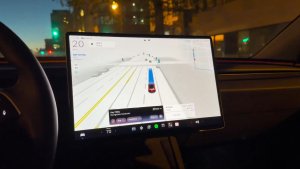
Tesla has also made some exceptions for its fastest and most aggressive mode. When Mad Max is enabled, an on-screen prompt will note “Increased attention required, Mad Max profile selected”.

This is similar to the prompt that previously appeared in poor weather, with reduced speeds in wet conditions.
The Path to Unsupervised
By enforcing attention during Mad Max mode or severe weather, FSD proves it is aware of its own operational limits. As the neural network grows more capable of handling complex environments natively, eliminating the need for constant human micromanagement is the exact psychological and regulatory stepping stone Tesla needs to reach an unsupervised, fully autonomous level.