Tesla’s FSD is trained on human driving and is increasingly mimicking the nuanced, unwritten rules that real humans drive by. Recently, owners have noticed a specific and highly relatable behavior. FSD will now proactively slow down, change lanes, and blend into traffic when it spots a police vehicle sitting in the highway median.
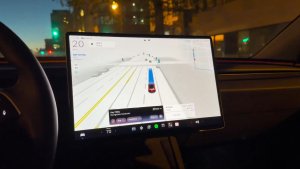
Another instance of Tesla FSD detecting a police truck in the median (pretty far away) then slowing down and moving over to blend in with slower traffic. This was in Hurry mode, speed limit 70 mph. Love it! pic.twitter.com/uH6FLkI1xM
— Sam D. (@SamuelD2022) May 22, 2026
Blending In
According to a recent post on X, a Tesla user reported their vehicle’s behavior after spotting a police vehicle in the highway median. FSD intelligently decelerated and moved over a lane to seamlessly blend in with the slower flow of surrounding traffic.
By matching the speed of the pack rather than passing the officer above the speed limit (70 mph), FSD successfully avoided drawing attention to the vehicle, acting exactly like a cautious human driver would in the same scenario.
The Power of End-to-End Learning
This human-like behavior is likely a result of the way Tesla’s end-to-end neural network learns and grows.
Because FSD is trained on millions of miles of real-world data gathered from actual drivers, it naturally adopts some human driving habits. Since the vast majority of human drivers instinctively hit the brakes and merge away from the fast lane when they see a vehicle parked in the median, the neural network simply learned that this is the correct, expected action to take.
Beyond Emergency Vehicles
While the neural network is explicitly trained to yield to active emergency vehicles with flashing lights, this specific median-dodging behavior appears to extend to almost any stationary vehicle.
Whether it is a police cruiser running a speed trap, a broken-down commuter car, or a highway maintenance truck, FSD has learned that giving vehicles on the shoulder a wide berth and a slower approach is simply a safe and most natural way to drive.