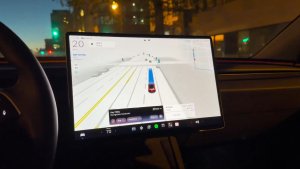
While FSD is becoming incredibly proficient at navigating complex city streets, the final 50 feet of a journey often remain a sticking point. Currently, FSD’s automated parking behavior is one of the most common triggers for driver disengagements.
Upon arrival at a destination, FSD frequently selects inappropriate parking spaces. Whether that means parking exceptionally far from the entrance in an empty lot, or pulling into a designated handicap or reserved spot, FSD seems to just park wherever it feels like.
To solve this and give the Tesla AI team some ideas, the community has started designing intuitive user interface concepts, in the hope that the next big FSD feature will focus on parking.
Granular Spot Selection
Recently shared UI mockups from the community show several approaches to the parking challenge. The concepts propose a system in which drivers can select their parking preferences before they even arrive at their destination.
One concept above features a drag-and-drop pin on a top-down satellite map, allowing the user to highlight a parking aisle or a general area.
Another, more granular concept shows a detailed render of a parking lot, complete with selectable blue boxes for "Spot A," a designated handicap space, and a private driveway.

In a perfect world, this level of control would entirely eliminate end-of-drive disengagements. The driver tells the car exactly where to go, and the vehicle executes the maneuver seamlessly.
The Mapping Bottleneck
While these community mockups look fantastic on the infotainment screen, the backend engineering required to make them work is likely a non-starter for Tesla.
To offer granular spot selection before a vehicle arrives, Tesla would need to know the exact, up-to-date layout of virtually every parking lot in every country. That is an almost impossible task, given just how fast parking lots and roads change.
While Tesla could rely on satellite imagery, similar to how Actually Smart Summon works today, satellite data is frequently outdated or obscured by trees.
Alternatively, Tesla could use its fleet to crowdsource and map parking lot layouts over time. However, building and updating a high-fidelity database of every parking lot just to populate a selection menu is an incredibly complex engineering hurdle that likely outweighs the benefit.
The Likely Solution
Rather than building bespoke parking systems based on the map, Tesla is more likely to lean into a simpler solution. The simplest and most effective solution is to let the vehicle's cameras identify available spots in real time upon arrival, but filter those choices based on preset user preferences.
Instead of tapping a specific spot on a map, Tesla could introduce a more extensive parking settings menu. This could include requesting that the vehicle be parked as close as possible to the entrance or in an area away from other cars.
Alternatively, tagging your vehicle as eligible for handicap-accessible parking when you possess a permit, similar to the HOV lane toggle, would simplify the experience for handicapped users.
Tesla has already been exploring ways to enable Grok to interact with FSD, and in the future, it may be possible to simply tell Grok about your parking preferences as well.
By changing the solution from complex pre-mapping to real-time, preference-based vision, Tesla can solve the FSD parking headache without reinventing its entire navigation architecture.