The continuous improvement of Tesla’s Full Self-Driving architecture relies on a complex feedback loop between human oversight and machine learning. FSD relies on end-to-end neural networks trained on vast amounts of both real-world telemetry and simulated training data, and human drivers today serve two purposes.
One is as a safety supervisor who is fully legally responsible for the actions of their vehicle. The second is as a data annotator when a manual intervention is required, signaling points for improvement back into the training loop.
With the deployment of FSD v14.2, and then the recent deployment of FSD v14.3.3 with the 2026 Spring Update, Tesla has changed how this loop is interacted with. By adding incentives to avoid FSD disengagement with the Distance Streak and Daily Streak features in the new Self-Driving App, Tesla is using psychological tools to change driver behavior.
This change in how FSD is perceived is both a sign of its success to date and a dangerous game Tesla is playing, one that could compromise both driver safety and the data flywheel that has made FSD so safe today.
High Score Illusion

The initial phase of this transition began subtly with FSD v14.2, which introduced a passive metric calculating the exact percentage of total miles driven under autonomous control. This addition, hidden away in a menu, sparked an immediate shift in owners' behavior, prompting many to attempt to maintain a pristine 100% autonomous miles-driven metric.
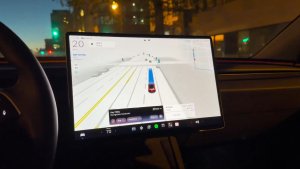
The 2026 Spring Update formalizes and accelerates this competitive impulse. By displaying the owner’s maximum distance between interventions prominently beneath the active vehicle speed indicator, Tesla has transformed a critical safety protocol into a space for a high score.
Because a single manual override, whether a tap of the brakes, a physical tug on the steering wheel, or a button press, instantly resets the distance metric to zero, the user interface has established a psychological penalty for human intervention.
After all, who doesn’t like seeing their high score go up endlessly?
Conversely, the system permits using the accelerator pedal or turn signals to prompt FSD without resetting the counter, creating a narrow, arbitrary boundary for what constitutes an “acceptable” driver input. The absence of explicit warnings or disclaimers, or even the ability to turn off this feature, suggests that Tesla sees it as a harmless engagement tool.
Gambling on “Wait and See”
While FSD has achieved statistical safety milestones that surpass the baseline of the average human driver, it remains susceptible to edge cases. Even Unsupervised Robotaxis in Austin have remote helpers to fix issues on the fly when something goes wrong.
Systemic errors, such as erratic path planning, misjudged lane changes, incorrect highway exits, or excessive hesitation or brake-stabbing at stop signs and shadows, remain a persistent issue for many owners.
Safety Reality Check
One may think a simple navigation error won’t be a critical safety issue, but taking a runaway truck ramp at highway speeds on FSD isn’t exactly a safe or pleasant experience, as someone recently experienced on a Cybertruck on FSD v14.3.3, the latest FSD build.
14.3.3 and my wife’s lack of observation =
— RedlineRory (@RedlineRory) May 29, 2026
Good thing it’s supervised still……🤮 pic.twitter.com/STJUg3ylU0
Under normal SAE Level 2 supervision parameters, a driver encountering an error would swiftly take over manually, just like the driver in the above video. That would preserve traffic flow and minimize risk to the driver, the vehicle, and those around them. The introduction of a Distance Streak completely upends this.
Faced with the impending deletion of a hard-earned multi-hundred-mile streak, drivers are incentivized to adopt a dangerous “wait-and-see” posture. When FSD is making a mistake, the driver is psychologically pressured to delay their intervention.
Owners are often willing to brave the absolute edge of structural danger in the hope that FSD corrects itself at the final second. In the video below, the Model Y that embarked on a coast-to-coast FSD trip was nearly totaled.
This delay in decision-making compromises the core benefit of FSD, which is to be safer than a human when supervised. Gambling with multi-thousand-pound vehicles at highway speeds isn’t safe.
FSD is amazing software, but for now, today, this moment in time, it is strictly still a Supervised L2 system. There’s a reason why Tesla’s unsupervised rides are limited to Austin. Those areas have received additional training and have been tested thoroughly. The rest of the country is not at the same level, and drivers will be liable for their actions.
Giving FSD Bad Data
Beyond the immediate, real-world traffic risks introduced by delayed reactions, gamification introduces another threat for Tesla. Tesla’s data flywheel is the true engine that improves FSD, processing millions of hours of data, complete with interventions, edge cases, voice notes, and other statistics, to improve the neural networks.
When a human driver manually disengages FSD because it performed an action that is illegal, uncomfortable, incorrect, or dangerous, that data is sent back to Tesla for training. Human interventions serve as a map of FSD’s operational boundaries and edge cases, and help to identify exactly what Tesla needs to improve on to achieve Unsupervised FSD. By not disengaging during uncomfortable or less than ideal situations, we’re essentially untraining FSD.
Penalizing manual disengagements with a public reset of a driver streak means that Tesla is disincentivizing the exact behavior its AI teams rely upon. When users suppress natural safety interventions to protect an arbitrary numerical milestone, they are actively starving Tesla’s data flywheel of high-value data.