The automotive industry at large faces a unique problem driven by a mismatch between marketing vocabulary and engineering reality.
Terms like “autonomous,” “self-driving,” and “robotaxi” are frequently used by manufacturers, whether legacy OEMs or innovators like Tesla, Rivian, Zoox, or Waymo. However, these terms often obscure the precise capabilities of the technology. To establish global clarity and help guide legal and policy decisions, SAE International and the International Organization for Standardization (ISO) maintain a classification system known as SAE J3016.
You’ve probably heard of this most often as “Level 2,” “L3,” or “L4/L5,” with confusing terminology like operational design domains thrown in. The J3016 guide is where those levels and terms come from, and it isn’t a subjective evaluation of a system's capabilities like FSD.
Instead, it's an engineering standard with a strict, step-wise division of labor between the human operator and the onboard vehicle software. The spectrum is divided into six SAE levels, fundamentally split between the blue advanced driver support features and the green automated driving features.
How Do the Levels Work?

Before we dive into how each level of autonomy works, we’ll explain the core terminology that systems engineers use to define autonomous software. The entire taxonomy of J3016 hinges on two foundational terms: the Dynamic Driving Task (DDT) and the Operational Design Domain (ODD).
The DDT encompasses all real-time functions required to safely maneuver a vehicle through on-road traffic. These are split into operational subtasks, such as steering to maintain lane position (lateral maneuvers), manipulating acceleration or braking (longitudinal maneuvers), and tactical subtasks such as maneuver planning, navigating intersections, and detecting and responding to objects.
The DDT completely excludes higher-level strategic decisions, such as picking a destination or scheduling a route.
The ODD, on the other hand, defines the exact boundaries under which a specific driving automation feature is designed to function. An ODD is a matrix of parameters that can include geofencing, time-of-day constraints, road requirements (such as access-controlled highways), weather limitations, or requiring the presence of clear lane markings.
Driver Support: Level 0 to Level 2
The lower half of the SAE taxonomy covers systems where the human behind the wheel remains in control. In these stages, the technology acts as an assistant, meaning the human is legally responsible for the vehicle’s actions at all times.
Level 0: No Driving Automation
At Level 0, the human driver performs the entire DDT, managing all steering, braking, and acceleration. While an L0 vehicle can be equipped with advanced safety systems such as Automatic Emergency Braking, Blind Spot Warnings, and Lane Departure Warnings, this still only makes it an L0 vehicle.
Level 1: Driver Assistance
Level 1 introduces ODD-specific automation of vehicle motion in either the lateral or longitudinal direction, but never both. A classic example of this is adaptive cruise control, which leaves acceleration to the vehicle but steering to the human driver.
Level 2: Partial Driving Automation
Level 2 represents the ceiling of human-supervised driving technology. At this level, the driving automation system simultaneously controls both lateral and longitudinal vehicle motion.
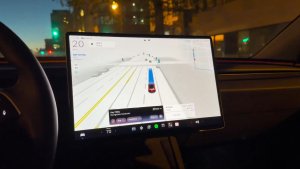
This is where consumer-facing platforms like Tesla's Full Self-Driving (Supervised) reside today.
Even though a Level 2 system can navigate complex urban environments, make turns, and change lanes, it is limited in its ability to respond to objects and events outside its operational domain (e.g., edge cases).
Because L2 software cannot guarantee a response to every unforeseen event, the human driver must constantly supervise the system and intervene immediately when an error occurs. Under Level 2, "you are driving" even if your hands and feet are completely off the physical controls.

Level 3 and the Fallback User
Moving from Level 2 to Level 3 requires a change in legal liability and operational authority. This is likely one of the major reasons Tesla has not yet pursued a level 3 system in certain scenarios.
At Level 3, the technology transitions from a driver-support feature into a true Automated Driving System (ADS). When a Level 3, 4, or 5 system is engaged, the software performs the entire DDT, meaning the human inside the vehicle is no longer actively driving.
Level 3: Conditional Autonomy
Level 3 allows the occupant in the driver's seat to completely disengage from the task of monitoring the road. They can legally take their eyes off the pavement to read a book or look at a secondary screen while the system handles the entire driving task within a limited ODD, such as dense highway traffic.
Mercedes-Benz deployed a commercial Level 3 platform, Drive Pilot, in select markets before eventually canceling the program due to its extremely limited ODD.
The defining caveat of Level 3 is the concept of the DDT Fallback. While the system manages normal operations, it does not guarantee it can handle a major vehicle failure or an unexpected departure from its ODD on its own.
Therefore, Level 3 requires a receptive "fallback-ready user" sitting in the driver's seat. When the system encounters an issue it cannot resolve, it issues a formal "request to intervene," giving the human a brief window of several seconds to regain situational awareness and assume manual control. If the human fails to respond, the vehicle initiates a baseline failure mitigation strategy, such as bringing the car to a controlled stop inside its active lane of travel.
True Autonomy: Level 4 and Level 5
The highest echelons of the SAE J3016 standard eliminate any expectation that a human user will ever need to step in and perform an emergency intervention while the automation is engaged.
Level 4: High Driving Automation
The technical divider between Level 3 and Level 4 is the automated management of the DDT fallback. A Level 4 system is engineered to handle the complete driving task and resolve any failures without human assistance.
If a Level 4 vehicle encounters a catastrophic tire blowout or a sudden whiteout snowstorm, it does not request human intervention; instead, it executes its own fallback protocol to safely achieve a "minimal risk condition," such as maneuvering onto a clear road shoulder and activating its hazard lights.
Because a human is never expected to take over, any occupants inside a Level 4 vehicle are legally classified as passengers. This is the foundation of the modern robotaxi industry.
Companies like Waymo and Zoox operate at Level 4, deploying driverless fleets within strictly geofenced municipal boundaries. Similarly, Tesla has recently achieved state-level commercial authorization to operate driverless vehicles in Texas, self-certifying its dedicated robotaxi software stack to Level 4 capability.
The core limitation of Level 4 is not its safety profile, but its dependency on a restricted ODD; the vehicle cannot operate outside its approved operational geofences.
Level 5: Full Autonomy
Level 5 represents the completion of autonomous engineering. A Level 5 system is the complete inverse analog of a Level 0 human driver, capable of performing the entire DDT and handling all fallback scenarios across an unlimited domain.
To achieve a true Level 5 rating, an ADS must be capable of navigating a vehicle anywhere on public roadways under all environmental and traffic conditions that a typically skilled human driver could reasonably manage.
There are no geographic constraints, weather exclusions, or regional geofences dictated by software limitations. If a vehicle's operation is restricted to a specific country or highway network due to software mapping boundaries, it technically fails the literal criteria for Level 5.
Because building an artificial intelligence capable of handling every imaginable real-world edge case globally is an astronomical computing challenge, true Level 5 technology remains a theoretical future milestone rather than a commercial reality on public roads today.
Recently, Tesla self-certified its robotaxi vehicles in Texas as a level 4, and that remains its goal for consumer vehicles in the future.