Tesla’s original success story was dictated by two things: the legendary Model S and the rollout of the Supercharger network. To try to repeat that success, Tesla is accelerating the rollout of the Megacharger network for the Semi.
Following the recent deployment of folding Superchargers for faster, cheaper installations, Tesla is now taking a similar approach with pre-assembled Megachargers to accelerate the commercial rollout of the Semi.
The Pre-Assembled Blueprint
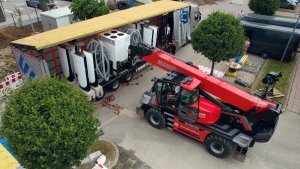
Instead of spending weeks trenching, pouring concrete, and connecting high-voltage busbars in the field, Tesla is doing the majority of the work at its factory. Upon arrival, the completed, pre-assembled unit simply needs to be dropped into a slot in a parking lot, connected to the grid, and powered on.
This plug-and-play approach results in massive savings and increases the speed at which Tesla can deploy new charging sites. Now, this proven Supercharger strategy is being adapted for the heavy-duty Megacharger network.

Improving Semi Charging
Deploying a Megacharger depot is a massive undertaking. The hardware is designed to deliver up to 1.2 MW of raw power to a single truck, enabling the Tesla Semi to recover up to 60 percent of its 500-mile range in just 30 minutes.
Facilitating that kind of electrical throughput typically requires extensive site engineering, complex local permitting, and weeks of specialized labor from high-voltage technicians. For logistics companies looking to transition to EV fleets, the time and capital required to build the infrastructure become friction points.
The pre-assembled Megacharger should help ease that friction by letting Tesla rapidly expand its Megacharger network. Delivering the Megacharger cabinet and posts as a factory-tested, pre-assembled unit eliminates the need for on-site assembly.
To help, Tesla also introduced a Wall Connector for the Semi called the Basecharger, which can provide up to 125 kW of power at warehouses. This is roughly 10x the power a Wall Connector can deliver.
As volume production of the Semi ramps up at Gigafactory Nevada, the demand for dedicated commercial charging will skyrocket.
By treating the physical charging station as a product rather than a construction project, Tesla is doing everything it can so its infrastructure scales just as quickly as its Class 8 EV truck.