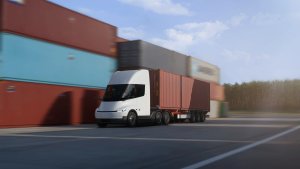
Dan Priestley, the Tesla Semi Program Lead, posted a video on X of a Tesla Semi undergoing low-friction winter testing. The footage is a classic worst-case scenario for a commercial tractor-trailer combination: a rapid side-to-side maneuver where the tractor pulled sharply left, then right. While the attached trailer fishtailed aggressively from side to side, the Tesla Semi itself remained stable.
Let's talk Vehicle Dynamics Control (VDC). With high resolution sensing and precise multi-motor controls developed in-house, the Tesla Semi provides torque and stability even on the trickiest of winter surfaces. pic.twitter.com/xNvCgyQCFc
— Dan Priestley (@danWpriestley) June 25, 2026
Preventing Jackknifing
For standard diesel rigs, low-friction surfaces represent an existential hazard. When a heavy trailer loses traction and begins to swing outward during a turn or braking event, it exerts a rotational force on the tractor's fifth-wheel coupling.
If the tractor's mechanical traction control cannot counteract this momentum, the trailer pushes the rear of the truck sideways, resulting in jackknifing.
Traditional trucks attempt to mitigate this through pneumatic anti-lock braking systems (ABS) and reactive traction management systems sourced from external suppliers.
The time delay required for a central controller to detect wheel slip, actuate pneumatic valves, and apply friction brakes is measured in hundreds of milliseconds. In a potential jackknife incident, that brief latency separates a successful recovery from a rollover accident.
Vehicle Dynamics Control
The flawless stability demonstrated by the Tesla Semi on ice, while loaded, is the result of a proprietary software suite known as Vehicle Dynamics Control (VDC). The platform relies on high-resolution sensing coupled with precise, in-house multi-motor control algorithms.
Rather than using a single internal combustion engine connected to a mechanical differential, the Tesla Semi uses an independent multi-motor powertrain layout that enables independent wheel torque control.

Because electric motors can change torque output almost instantaneously, the Tesla Semi's VDC core can alter power delivery to individual drive wheels within microseconds. When the high-resolution sensors detect that the trailer's lateral momentum is beginning to push the tractor off its intended path, the VDC executes micro-adjustments to the motors.
It can simultaneously apply positive torque to one wheel while utilizing regenerative braking on another, generating a counter-yaw moment that neutralizes the trailer's kinetic energy before it can destabilize the tractor.
Vertical Integration at its Finest
Legacy commercial truck manufacturers function primarily as vehicle assemblers, sourcing engines, transmissions, and stability control systems from third-party component suppliers. This fragmented approach limits their ability to optimize vehicle control loops because the software is often integrated into each component rather than centralized at the vehicle level.
Because Tesla engineers everything from hardware to software, it enables perfect integration of every component, from the VDC software to the physical motors in the vehicle. Tesla can sample traction in real-time, just like it does for its consumer vehicles, and predictively adjust settings to preserve stability.