The dream of a purpose-built robotaxi fleet cruising down city streets without any physical driver controls just took a major leap forward. Tesla on Tuesday dropped a big update on social media, showing a production version of its Cybercab operating entirely on its own out in the wild.
The official @Tesla account on X confirmed that the team has started conducting the first engineering tests of self-driven Cybercab units without steering wheels, pedals, or any other kind of human controls in Austin. The announcement came bundled with a video showing the vehicle seamlessly navigating everyday Austin traffic and comfortably cruising down city streets with absolutely zero input from a human.
Engineering tests of the first production Cybercab have begun in Austin pic.twitter.com/fk3KQvcE8a
— Tesla (@Tesla) June 30, 2026
Cybercab Engineering Tests
This public-road validation is happening in Austin, not far from the factory floor at Gigafactory Texas. This is where Tesla officially kicked off Cybercab mass production back in April and has been steadily expanding its manufacturing lines ever since. For these early validation runs, the vehicle is driving with a safety monitor riding along in one of the two passenger seats.


While having a supervisor on board is standard for testing, it isn’t a realistic long-term path for this specific vehicle platform. When Tesla originally launched its Robotaxi service last summer with retrofitted Model Ys, having an employee ride along in the front passenger seat worked as a temporary safety cushion.
However, because the Cybercab is explicitly a two-seater, keeping a safety monitor in the cabin would permanently cut passenger occupancy capacity by half. If Tesla wants to scale the vehicle the way it always intended — without a steering wheel or pedals, it has to move past this testing phase, bypass the need for an in-car monitor, and clear the regulatory path to deploy them natively across the Robotaxi network.
What's On the Screen
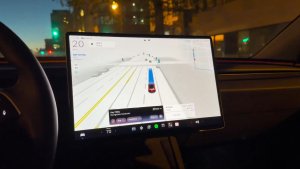
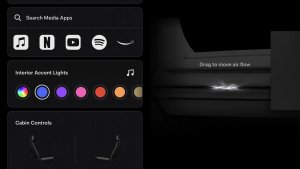
Since there are no pedals or steering wheels inside the cabin, the central touchscreen handles everything for riders. The visualization on the central interface differs slightly from what you see in consumer Teslas. The navigation display shows a sharp gold Cybercab, with the familiar blue Full Self-Driving pathway extending from it to outline the route.
We can see the Cybercab is in its driverless 'Autonomous Mode' from the blue "Self-Driving" text visible in the notification area in the top left corner of the screen. The left side of the screen also keeps passengers updated with a clear estimated time of arrival.

For entertainment, the bottom row of the display features standard media controls and streaming apps, but it also introduces a new "Pull Over" button in the left corner for emergency stops and a "Support" button on the right to contact Tesla’s Robotaxi Support. Once the vehicle comes to a complete halt, these two automatically swap out for dedicated "Open Door" buttons for each side.
Prepping for a Public Launch
Seeing completely driverless production builds undergoing validation means a consumer rollout is closer than ever. As noted by @scotsrule08 on X, the Texas Department of Public Safety recently updated its official Connected Autonomous Vehicles database to include the Cybercab. The robotaxi joins the Model Y on that state list, which has been successfully providing fully autonomous rides across Austin, Houston, and Dallas.
🚨 BREAKING: Texas DPS has officially added the Tesla Cybercab Robotaxi to their Connected Autonomous Vehicles First Responder Interaction Plans page.
— Spencer (@scotsrule08) June 29, 2026
This is a significant milestone. Cybercab launch in Texas is getting very close. https://t.co/UTPHIrBOUH pic.twitter.com/btkE5EMOKP
The regulatory landscape is clearing fast. While Tesla previously mentioned a willingness to add a steering wheel and pedals as a backup plan if regulators blocked a wheel-less design, it currently appears to be sticking to its original vision.
The road to the Cybercab’s public debut got much smoother after NHTSA dropped its brake pedal requirement for autonomous vehicles, and Tesla self-certified its FSD-driven cars as SAE Level 4 autonomy-compliant under a new Texas law. Tesla recently published its Cybercab First Responder Interaction Plan to outline the safety side of the vehicle's public operations, and the manual explicitly states that it operates in an SAE Level 4 'Autonomous Mode.'

With Austin not only being Tesla's manufacturing and testing hub for the Cybercab but also the home base for the Robotaxi service, it will almost certainly host the first public Cybercab rides once steering wheel-less validation wraps up. But Tesla’s plans reach much further than Austin. A recent photo shared on Reddit showed a fleet of over 70 production Cybercabs already sitting in a staging lot in the Dallas medical district, indicating a multi-city expansion won’t be too far behind.