Tesla’s Full Self-Driving (Supervised) software does more than just steer your car safely through traffic. It turns out it’s actually a much smoother driver than you are.
Tesla released its 2025 Impact Report this week, sharing real-world metrics that prove software logic beats human acceleration habits when it comes to saving power. “We sampled real-world data from 65 million miles driven in 2025, showing that driving with FSD (Supervised) engaged uses less energy compared to traveling the same distance manually, lowering overall GHG emissions in the process,” Tesla said in the report.
Smoother Driving Means Fewer Emissions
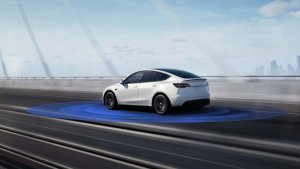
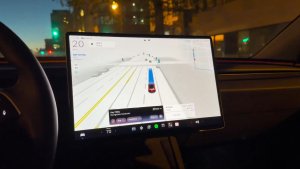
The numbers reveal that FSD operates roughly 5% more efficiently than the average human driver. FSD’s optimized driving style lowers greenhouse gas emissions directly at the power generation source. Interestingly, the system’s efficiency peaks in the 25-35 mph range, which Tesla noted is squarely in the range of typical urban and suburban driving.

FSD’s efficiency advantage will soon benefit a much larger portion of Tesla’s existing consumer fleet, as the team recently began rolling out FSD v14 Lite for older cars with Hardware 3 computers. V14 Lite is a distilled, optimized version of the main FSD v14 branch, bringing the latest FSD capabilities — and, by extension, energy efficiency — to older hardware configurations.
Cybercab Takes Efficiency to the Next Level
While consumer vehicles are already saving on GHG emissions by using less power, Tesla noted that its upcoming Cybercab robotaxi will take things to a whole new level. “With full autonomy and maximized ride efficiency, our Cybercab robotaxi will further reduce GHG emissions per mile, helping to avoid nearly twice as many GHG emissions per mile compared to Model 3 and Model Y,” the report reads.

This would translate to an impressive 10% efficiency lead over human drivers. The efficiency bump doesn’t come as much of a surprise, especially given how we recently found out the Cybercab secretly has a more advanced FSD computer that isn't available on Tesla's current consumer models and can run ever larger self-driving models.

The vehicle itself is also built to be incredibly energy-efficient at 165 Wh/mi (roughly 6.1 mi/kWh), with leadership suggesting it could easily become the most efficient EV ever manufactured. With mass production kicking off at Gigafactory Texas earlier this spring, Tesla is quickly working toward a public launch. Road validation has been in full swing for months, and Tesla started testing production Cybercab units, complete with their defining lack of a steering wheel and pedals, on public roadways in Austin last week. We might just get to see how much more efficient the Cybercab is compared to the rest of Tesla's models pretty soon.