Tesla just released its comprehensive 2025 Impact Report, framing the latest milestones in its core mission of achieving “amazing abundance.” The full 216-page report covers Tesla’s complete ecosystem of vehicles, energy products, and manufacturing footprint. One major takeaway is how much the current Tesla lineup reduces humanity’s global environmental impact, while setting the stage for future autonomous Cybercab fleets to push those efficiency limits even further.
According to data shared in the report, Tesla customers avoided releasing nearly 37 million metric tons of CO2e into the Earth’s atmosphere over the course of 2025. To put that number into perspective, it’s the equivalent of driving an internal combustion engine vehicle about 90 billion miles. Over a full operational lifespan, Tesla estimates that each individual vehicle avoids roughly 32 tons of emissions during 17 years of driving.

Clean Energy and Growing Battery Recycling Numbers
The sustainability push extends well beyond just the cars on the road. In 2025, Tesla Solar customers generated over 2.1 times the electricity needed to power all Tesla manufacturing, support, sales, research, service, and delivery locations across the globe.

The circular economy for battery manufacturing is also accelerating. “In 2025, we recycled over 14,000 metric tons of battery material through a combination of in-house processing and through our network of recycling partners,” Tesla said in the report. That translates to the equivalent of 46,000 long-range battery packs, marking a 20% increase from the recycling figures recorded in 2024.
Factory Efficiency Wins at Berlin and Texas
Manufacturing efficiency saw massive improvements at global production hubs. At Gigafactory Berlin, water conservation became a major highlight. “While Tesla is permitted to consume 1.4 million cubic meters of water per year, we only consumed a fraction of that in 2025 - about 0.3 million cubic meters, down from 0.45 million cubic meters in 2024,” the report noted. The facility reduced consumption by launching an on-site industrial water recovery and recycling plant that recycles up to 100% of the factory’s process wastewater.

Meanwhile, Giga Texas is tackling energy consumption inside its computing infrastructure. “At Gigafactory Texas, we are planning to implement a waste heat recovery system in our data center,” Tesla said. “This system captures waste heat and repurposes it to provide process heating water to our vehicle coatings and paint shops, reducing the need for water from our chiller plants.”

Back in 2024, Tesla also started building a water-cooled supercomputer cluster at Giga Texas to power AI development. The latest data center optimizations also include improvements to chiller efficiency during colder and drier months to maintain optimal cooling performance while cutting down power usage.
Software-Driven Efficiency and Next-Gen Hardware
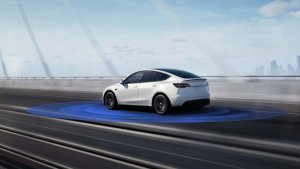
Efficiency gains aren’t just coming from hardware tweaks. Tesla’s Impact Report revealed that software plays a huge role in optimizing energy use on public roads. Per data collected across 65 million miles, Tesla FSD uses roughly 5% less energy than the average human driver to travel the same distance, directly cutting emissions at the power generation source.
Looking ahead, Tesla expects these environmental metrics to skyrocket with the upcoming Cybercab. The 2025 Impact Report was also chock full of details on the purpose-built robotaxi vehicle, outlining its record-breaking efficiency of 6.1 miles per kWh, fully autonomous operation, and 48-volt architecture. As production and software capabilities scale up globally, the path toward the sustainable, abundant future Tesla envisions in its mission statement is becoming much clearer.