Tesla recently released its 2025 Impact Report, which not only highlighted its environmental achievements over the past year but also outlined some efficiency expectations for its upcoming purpose-built robotaxi vehicle, the much-anticipated Cybercab. The data provides an interesting look at just how clean autonomous transport could become compared to gas guzzlers.
“Cybercab will be built on our next-generation platform, with a powertrain that is expected to deliver at least 6.1 miles per kWh, further reducing energy cost per mile,” Tesla said in its report. According to Tesla, the Cybercab is nearly twice as efficient as the Model 3 and Model Y and results in roughly half the emissions, leaving the rest of the all-electric competition squarely in the dust.
But that’s not all — the report included a graph comparing the Cybercab’s emissions per mile (in g CO₂e/mile) to the Model 3/Y and similar ICE vehicles. We measured it in pixels, comparing the Cybercab’s reading to the one for ICE vehicles, and if Tesla’s graph is accurate, the Cybercab only adds 1/8th the greenhouse gas (GHG) emissions to humanity’s environmental footprint as a standard gas-powered vehicle.

Cleaner Power = Even Lower Lifecycle Emissions
While ICE vehicles give off greenhouse gases as they burn fuel on the road, electric vehicles run on grid power. They don’t burn fuel while driving, but they still contribute to emissions because global power generation is far from 100% clean today. In the U.S., fossil fuels still account for over 50% of energy generation. However, this also means that the Cybercab’s emissions will drop even further as the grid transitions toward renewable sources like solar and wind.
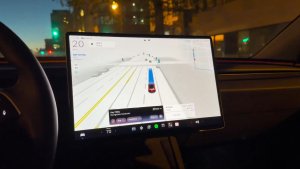
The overall environmental savings are also supported by operational software efficiency. Tesla’s Impact Report details big climate achievements across the board, including data showing that Full Self-Driving is 5% more energy efficient than the average human driver. This means that the Cybercab's fully driverless operation could squeeze even better numbers out of its already more efficient powertrain and battery architecture.

Cutting Emissions Right on the Assembly Line
Vehicle manufacturing and battery production usually generate their own share of environmental overhead, but Tesla is using its new “unboxed” manufacturing process to change things up. The report highlighted a new paint process for the gold-colored Cybercab that further reduces its ecological impact by skipping a standard automotive paint shop entirely:
“Our new reaction injection molding (RIM) process, engineered for Cybercab production, reduces manufacturing cycle times from hours in a traditional paint shop to just minutes with paint being injected during the molding process,” Tesla said. “For the parts put through the RIM process, supply chain and manufacturing GHG emissions are cut by 35% - and unlike traditional paint processes, this change has also eliminated volatile organic compound (VOC) emissions. This substantial leap in efficiency and sustainability underscores our commitment to scalable, low-impact innovation.”

The Cybercab’s efficiency numbers are currently internal estimates since the U.S. EPA hasn’t officially rated the vehicle yet. That said, Tesla is already well into Cybercab mass production and public validation, and remains confident in its efficiency estimates for the vehicle. Tesla recently started testing production Cybercab units without a steering wheel, pedals, or any other manual driving controls on public roads in Austin, indicating that a launch is getting closer.
The Cybercab is also set to start offering autonomous rides to Tesla employees at Giga Texas ahead of the vehicle's public debut on the Robotaxi network. Elon Musk and Tesla leadership have said the Cybercab will be the most efficient EV ever built. Executives have even teased that it could beat the 6.1 miles-per-kWh estimate once it officially launches.