The debate around whether FSD is ready to go unsupervised has been a hot topic for quite a while, especially following the release of FSD v14. Much of the debate compares empirical data in government-mandated testing environments to the real-world use of FSD by owners.
Recently, I put in nearly 8,000 miles on my Cybertruck, starting in Ottawa, Ontario, going to Los Angeles, California, and back - while hitting nearly every major national park on the way. I subjected FSD to a transit across North America - one that saw various types of terrain, different traffic laws, and entirely strange types of local intersections from one end to the other.
So the question is, is FSD ready to be unsupervised in certain regions? If not, should Tesla ease into it by introducing eyes-off highway driving?
North America in a Nutshell
The primary hurdle for any autonomous driving system is specificity versus generalization. AVs like Waymo that perform well in familiar urban environments often can’t handle new regional demands or road types without additional training or mapping. On the other hand, a generalized system like FSD is designed to take on any road, anywhere.
Over the course of my journey, the Cybertruck navigated nearly everything North America could throw at it - from high-speed open highways in the American Midwest to the tight, unforgiving switchbacks in the Rocky Mountains.
Beyond the roads, FSD proved just how effortlessly it can handle dense, erratic city traffic. Whether driving through Chicago’s highways, in the six-lane roads of Las Vegas, or through the dense traffic of Los Angeles, FSD never failed. It navigated anywhere — and most importantly, strange intersections were never a problem - not even the criss-cross highway-to-roadway interchanges in Nevada.
That makes one thing clear: Tesla’s strategy to generalize autonomy is working, and it is working extremely well.
The Safety Metric and Sole Intervention
When considering whether FSD is ready to lose its “Supervised” label and offer complete autonomy, there’s only one key metric that actually matters — safety-critical interventions. Over nearly 8,000 miles of driving across different US states, I only had to step in once with a single safety-critical intervention.

Even more telling than the low disengagement rate is why I had to take over. The intervention wasn’t a software issue, a mapping error, or a sharp mountain pass, but rather the result of a human driver.
When a vehicle can handle the sharp switchbacks in Yosemite and then seamlessly transition to the dense urban traffic in LA without a single system-initiated safety failure, it’s nearing the threshold of being unsupervised.
Finalizing Convenience
To be completely fair, the drive wasn’t entirely seamless, but there is a fine line between safety-critical flaws and minor convenience issues. The remaining friction points across this trip fell squarely into the latter camp.
First, the current behavior of the driving modes (Mad Max, Hurry, Standard, Chill, and Sloth) still leaves much to be desired, especially with speed control, and, unfortunately, Tesla has stated that it’s not going back. The various modes still struggle to adhere to posted speed limits, often going well above them and at other times not keeping up with traffic.
For example, when travelling in California to the Grand Canyon on Route 66, FSD would not drive any faster than 45 mph in a 55 zone on Standard or Hurry, but would drive at a breakneck speed of 70 mph on Mad Max. Either 10 slower than the posted speed limit or 25 mph higher.

Second, highway navigation is still a bit of a headache. FSD occasionally decided to take random, incorrect highway exits. While these routing hiccups were totally safe moves that didn’t put anyone in danger, they added unnecessary time and mileage to long stretches of the trip.
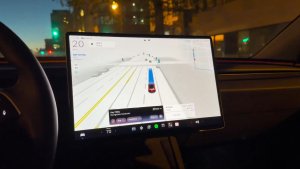
Third and finally, parking. On a vehicle as large as the Cybertruck, parking is still a challenge for FSD. It frequently tried to back into closed charging stalls (even though it shows me which ones are closed on screen with the new 3D site maps), and when it did pick an active one, it failed to reverse close enough to connect.
This is especially true for older V2 Supercharger posts with notoriously short cables, which are prevalent in the Midwest and desperately in need of replacement. However, at the end of the day, it's just an annoyance to have to re-align the truck after it parks or to intervene during parking, not a deal-breaker.
The Show Must Go On
The takeaway from my road trip is simple: the current list of FSD complaints is mostly surface-level bugs. That means speed mode shenanigans, routing detours, and parking issues. These impact trip efficiency, ride feel, and driver patience, but they don’t impact FSD’s physical safety.

Because FSD is so effectively generalized, it can successfully parse unfamiliar regional traffic laws, different types of terrain, and human unpredictability across the United States.
Robotaxi
Tesla has been extremely cautious with the Robotaxi rollout in Austin and more recently in other parts of Texas and Florida. Tesla is carefully evaluating each area, potentially providing additional training where needed and ensuring FSD can handle those roads perfectly.
So this raises the question: when will consumers gain access to the same level of autonomy that robotaxis already have in select regions, and should Tesla perform the same level of sanity checks and additional training on highways across North America?