Elon Musk has revived Tesla’s long-running plan to help vehicles avoid potholes. Yesterday, Musk responded to a driver who was requesting FSD to actively avoid potholes. Musk simply stated that the feature is coming soon.
While Musk didn’t provide any additional details or hint at which FSD version would include the feature, we expect it to arrive fairly soon, potentially before FSD v15.
This is an interesting feature and could lead to a lot more than the vehicle simply driving around a pothole.
Pothole Support Is Coming
Tesla has listed pothole avoidance as an upcoming improvement since FSD v14.3, which was released on April 7th, 2026.
Vehicles running current versions of FSD can sometimes be seen steering around large potholes. One recorded example showed FSD v14.2.2.5 positioning a vehicle so the damaged section passed between its tires. Whether FSD thought it was an object in the road or a pothole, isn’t very clear, but the vehicle is sometimes avoiding potholes currently. However, what we can expect is much more consistent behavior, even for smaller potholes,
A Long Time Coming
The idea of having the vehicle avoid potholes dates back to April 2019, when a Tesla owner asked for small steering adjustments within a lane to protect tires from potholes. Musk agreed with the request, but the feature was likely pretty low in Tesla’s list priorities.
Musk later said in 2020 that air-suspension height and damping would connect with FSD and respond automatically. Tesla added automatic adjustments for upcoming rough roads to Model S and Model X through update 2022.20. However, that suspension project now has a narrower path forward after Model S and Model X production ended, leaving Cybertruck as Tesla’s sole vehicle with adjustable air suspension.
Besides HW4 having more memory and compute power than HW3, it also has cameras with 4.5x higher resolution, which makes it much more capable of detecting potholes on the road.
Building and Sharing Road Data
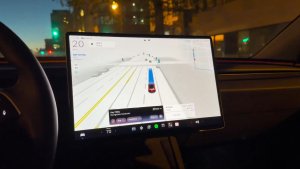
Tesla already has a foundation for fleet-based road mapping. The adaptive-suspension system uses rough-road map data generated by other Tesla vehicles that then allows vehicles with an air suspension to automatically adjust before reaching the rough patch of road.
If Tesla follows suit for pothole detection, Tesla could create a user-generated map of large potholes to avoid. Advanced notice of a pothole could let a vehicle prepare to avoid a pothole, or favor a smoother lane entirely.
A large pothole database could also help local governments know about issue and even prioritize repairs based on the largest potholes or the ones that are encountered the most. While Tesla has not announced plans to share this kind of information, it’s something that we can all potentially benefit from.