Between public regulatory compliance filings and newly published rider handbooks, not to mention last week’s launch event in Austin, we now have a comprehensive breakdown of the dimensions, mechanical packaging, and custom thermal hardware powering Tesla’s Cybercab.
The technical deep dive arrives right as Cybercabs begin offering commercial public rides in Austin and was made possible by information shared by @SawyerMerritt and @itskyleconner. While attendees experienced the vehicle firsthand during the official Cybercab launch event last week, the newly revealed hardware details demonstrate how radical cost engineering shaped every component.
Supermanifold V3 and Rare-Earth-Free Drive Unit
Thermal management is anchored by an evolved cooling loop called Supermanifold V3, marking its first appearance on a production Tesla. The unified manifold eliminates standalone external valves and plumbing hoses while consolidating high- and low-voltage controllers onto a central block.

Tesla touted some of the hardware improvements in its engineering overview:
“We removed unnecessary refrigerant valves and lines and consolidated the high-and low-voltage controllers, reducing parts and complexity. Its modular design makes its production 80% automated and its operation 38% more efficient than other automotive thermal systems.”
Propulsion comes courtesy of a single front-wheel-drive permanent magnet motor outputting 163 kW (219 horsepower). The stator uses bar windings and a simplified lubrication circuit, allowing the drive unit to be assembled in under ten seconds. The complete assembly is 18% smaller and 25% lighter than competing electric vehicle drive units.

Elon Musk confirmed that the motor doesn’t use any rare earth metals, avoiding critical supply chain bottlenecks:
“The Cybercab motor uses no rare earth metals, but maintains the same range!
This was extremely hard to achieve.”

Energy storage relies on a structural pack featuring dry-cathode 4680 cells with a calculated usable capacity of 47.6 kWh. The battery is engineered to endure 500,000 miles of continuous DC fast charging and harsh temperature swings. In preliminary multicycle range testing, the setup achieved an unadjusted 418.2 miles, which translates to roughly 293 miles under typical EPA 5-cycle adjustments at an efficiency rating of 6.16 miles per kWh.
Chassis Engineering and Autonomous Sensor Suite
Under the injection-molded gold exterior panels, the chassis skips standard automotive fluid lines. Braking relies on individual electromechanical brake-by-wire actuators on each caliper without a central hydraulic master cylinder or brake fluid. The steer-by-wire steering rack is mounted behind the front drive unit, operating on an updated 48-volt electrical architecture.

Autonomy compute is powered by an improved self-driving computer based on Hardware 4 architecture with iterative silicon updates. Tesla hasn’t revealed the exact specs, but we know it’s more powerful than what consumer vehicles are currently being sold with. The accompanying sensor suite consists of nine cameras: eight outward-facing units monitoring surroundings and one cabin-facing camera. The internal camera scans between trips to check cabin cleanliness and spot left-behind belongings, illuminating a green onscreen icon whenever it is active. Tesla is building out a network of Robotaxi hubs to clean and charge vehicles between rides.

Rider safety relies on an overhead radar module mounted near the dome lights that acts as an Occupant Classification System. The radar determines whether a seat is empty, occupied by a child seat, or seating an adult, enabling or disabling passenger airbags automatically. Airbag protection includes front, knee, curtain, and dual seat-mounted side airbags.
Exterior Dimensions and In-Cabin Packaging
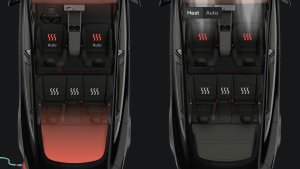
Despite the Cybercab’s small footprint, interior volume is roomy. With no steering column or pedals taking up space, the cabin provides 43.4 inches of legroom, 38.3 inches of headroom, and 50.1 inches of hip room. The seats slide forward and backward as a single linked bench, while each backrest reclines independently. There’s no active heating or ventilation for the seats, but the Cybercab will already be warm when it picks you up. Individual air vents allow each rider to turn off their own climate airflow manually.
Vehicle Specification | Measurement |
|---|---|
Overall Height | 55.4 inches |
Overall Width | 69.0 inches |
Ground Clearance | 5.7 inches |
Step-In Height | 16.5 inches |
Curb Weight | 3,113 lbs |
Gross Vehicle Weight Rating (GVWR) | 3,730 lbs |
Total Payload Capacity | 617 lbs |
Rear Trunk Cargo Volume | 20.2 cu ft (572 L) |
Max Trunk Weight Limit | 220 lbs (100 kg) |
The rear cargo area holds two checked bags alongside two carry-on suitcases, or a folded stroller or compact wheelchair. Child seats must be secured using vehicle seat belts, as the seats lack lower LATCH anchors.
Cabin entertainment centers around a massive 22-inch touchscreen. While riders can already plug in game controllers, Musk recently teased that you’ll be able to plug gaming consoles into Cybercab down the line. Built-in USB-C ports keep mobile devices charged (there’s no wireless phone charging), and Cybercabs are being built with integrated Starlink dishes for low-latency satellite connectivity in the future.
By pairing Tesla’s ultra-lean “Unboxed” manufacturing process with autonomy, the Cybercab establishes an unprecedented benchmark for purpose-built fleet efficiency.