Tesla has kicked off a dual-branch software rollout that caters to both current-generation hardware and legacy vehicle platforms. According to newly surfaced release notes for software update 2026.27.6, Tesla is officially deploying Full Self-Driving (Supervised) v14.3.9 alongside a fresh v14.2 Lite build for Hardware 3 (HW3/AI3) vehicles.
The update delivers the new Automatic Collision Evasion feature that we previously spotted, though the release establishes a clear hardware divide. While newer cars receive active safety interventions that trigger during manual driving, older vehicles remain on a separate branch tailored around hardware limits.
FSD v14.3.9: Automatic Collision Evasion for HW4
The headline addition in FSD v14.3.9 is Automatic Collision Evasion. The capability was first spotted in Tesla’s owner’s manual last week, and Tesla later confirmed it would be rolling out to customer vehicles with FSD v14.3.9.
Automatic Collision Evasion turns the car over to FSD if you’re driving manually and the vehicle detects that a crash you otherwise couldn’t easily avoid is about to occur. The release notes clarify that the feature is exclusive to vehicles running Hardware 4 (HW4/AI4) FSD computers. It also requires an active FSD purchase or subscription, as well as both Automatic Emergency Braking and FSD (Supervised) being enabled in the vehicle’s settings.

Automatic Collision Evasion activates in two main driving situations when you are operating the car manually:
Imminent frontal collisions: If the vehicle determines that braking alone will not avoid a crash with another vehicle on a controlled-access highway under 85 mph, it automatically steers around the hazard onto the road shoulder or into an open lane. During the maneuver, the accelerator pedal is muted, and the car resists accidental driver cancellation, requiring firm steering torque to override.
Inattentive drivers: Between 22.5 mph and 85 mph on any road type, the car can automatically take the wheel if the cabin camera detects you aren’t paying attention or if it concludes that FSD (Supervised) was unintentionally turned off.

Once the emergency maneuver wraps up, the car transitions into a degraded autonomous state, plays a chime, and asks the driver to take over. Beyond this new active safety feature, FSD v14.3.9 also brings some general FSD improvements, but the release notes remain the same as previous v14.3 revisions.
FSD v14.2 Lite: Improvements and UI Tweaks for HW3
Alongside the new flagship build, Tesla is pushing FSD v14.2 Lite to vehicles equipped with older Hardware 3 computers. This marks the second update to the Lite branch after the updated build in July that brought new features and kicked off a wider public release.
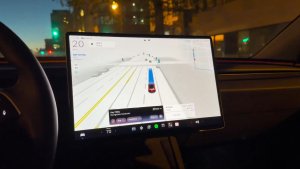
While the release includes FSD improvements, the notes don’t detail the underlying model upgrades. Early testers, however, have also noticed some subtle UI changes. The onscreen Park and navigation destination pins now sport a crisp white border, and the destination icon dynamically shifts based on your chosen Arrival Option.

This could also be the release that finally broadens vehicle eligibility. Tesla AI lead Ashok Elluswamy confirmed this week that FSD v14 Lite is coming to Model S and X, and while early access sightings currently remain limited to Model 3 and Model Y, wider waves could fold in the older flagship cars.
The appearance of v14.2 Lite suggests an eventual v14.3 Lite could follow down the road. However, owners should keep expectations grounded — v14 Lite will likely be the end of the line for HW3 until Tesla starts offering hardware upgrades to newer FSD computers.