Tesla’s dual-branch Full Self-Driving (Supervised) rollout is now hitting customer driveways, giving us our first look at how both hardware generations handle real-world streets on the latest software. After Tesla began deploying FSD v14.3.9 and FSD v14.2 Lite as part of software update 2026.27.6, early access drivers have been sharing in-depth feedback across highway road trips and local commutes.
While Hardware 4 owners get a headline safety feature in Automatic Collision Evasion, drivers of older Hardware 3 vehicles receive an improved distilled model, and community impressions reveal noticeable progress across both software branches.
FSD v14.3.9: Snappier Decisions and Highway Road Trips
For current-gen HW4 vehicles, FSD v14.3.9 delivers a sharper driving personality. Early tester @BLKMDL3 reported that decision-making feels faster and more assertive when navigating in Hurry mode, specifically during lane changes and intersection creeping. The latency between evaluating an opening and committing to a maneuver has noticeably dropped compared to v14.3.8. Destination street parking also improved, pulling up closer to driveway thresholds rather than stopping too far back.
On the highway, tester @DevinOlsenn took the software on an extended road trip through British Columbia, describing the system as a safe and comfortable long-distance driver that stays well-centered. However, familiar road-trip pain points remain. Testers noted that the software still misreads speed limit drops near small towns a lot of the time, necessitating manual speed profile changes to keep up with traffic flow. Left-lane lingering after passing slower vehicles also persists unless nudged with the turn signal stalk.
FSD V14.3.9 Road Trip Timelapse
— Devin Olsen (@DevinOlsenn) September 9, 2026
If you're road tripping without FSD you're missing out - truthfully it makes long drives a total breeze.
Also who know's what the song is from 😏 pic.twitter.com/vQWZf6FWtw
The headline addition with FSD v14.3.9 is Automatic Collision Evasion for manual driving, with the rest of the release notes being carried over from previous versions. The new feature automatically engages FSD (Supervised) if the vehicle thinks there’s going to be a crash or if it determines that FSD was mistakenly disabled. While testers are planning closed-course tests to safely evaluate Automatic Collision Evasion’s emergency swerve behavior, the broader day-to-day drive feels like a solid, polished point release.

FSD v14.2 Lite: Smarter Look-Ahead and HW3 Refinements
For older HW3 vehicles, v14.2 Lite marks a noticeable step forward. This represents the second major update to the distilled architecture since it received a bunch of new features and went into wide release in July. Tesla also confirmed this week that v14 Lite is supposed to land on HW3 Model S and Model X vehicles imminently.
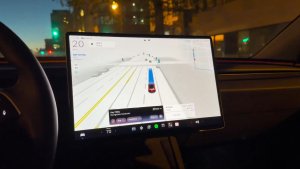
Community member @koby_pierce logged over 100 miles on the new Lite build, praising confident parking adjustments. The car successfully reversed into tight third-party charging stalls where previous iterations failed. Testers also observed that curbside pull-over instructions behave more naturally, leaving ample clearance for passing traffic. Drivers also welcomed a minor UI update that gives the on-screen parking pin a clean white border for better contrast, as well as some other interface tweaks.

Meanwhile, @BLKMDL3 noted that v14.2 Lite thinks several steps ahead in residential neighborhoods. When approaching speed bumps followed immediately by stop signs, the car tempers speed smoothly using regenerative braking without unnecessary acceleration bursts between obstacles. It also pre-selects inside or outside turning lanes to avoid getting boxed in after making a turn.
Low-speed steering wheel wobble around 40 mph is visibly reduced on v14.2 Lite, though not completely eliminated on every type of road. As owners wait for these builds to roll out beyond early access groups, the releases prove that Tesla is finding extra polish across both silicon generations.