Following months of speculation, Tesla has officially announced the launch of the Semi in Europe. After Tesla confirmed last month that the Semi would be coming to Europe, official regional web portals have gone live, laying out technical specs, payload limits, and a delivery roadmap for commercial freight operators.
The official confirmation was shared on X by the @teslaeurope account. Customer deliveries in the region are officially slated to kick off in 2027, giving logistics providers a rough timeline to plan fleet transitions away from diesel.
Tailored Specs and European Megacharging
According to Tesla’s newly published German Semi website, the commercial electric tractor boasts an estimated energy consumption of 1.0 kWh/km, delivering up to 550 km (about 342 miles, so the version launching in Europe is equivalent to the Standard Range Semi available in the U.S.) of range while hauling a full 40-metric-ton gross combination weight. Here’s a quick snapshot of the Tesla Semi’s specs for Europe:
Spec | European Tesla Semi |
|---|---|
Range | 550 km (estimated) |
Energy Consumption | 1.0 kWh/km (estimated) |
Fast Charging | Up to 60% in 30 minutes |
Charing Standard | MCS 3.2 |
Powertrain | 3 independent motors on rear axles |
Drive Power | Up to 800kW |
Curb Weight | 9,100 kg |
ePTO* | Up to 25kW |
*ePTO is the Electric Power Take-Off, which can run trailer functions like refrigeration.

European Semi customers will have two tiers of charging hardware to choose from:
Megacharger: Delivers up to 800 kW of power (vs. up to 1.2 MW in the U.S.), replenishing roughly 60% of the battery pack in 30 minutes during standard driver rest breaks.
Basecharger: Operates at 120 kW, designed for overnight charging at logistics depots to restore 60% range in about four hours.

The powertrain pairs three independent electric drive motors on the rear axles, pushing peak drive power up to 800 kW without needing a manual transmission or diesel exhaust fluid. Fleet buyers also get ePTO functionality outputting up to 25 kW to run auxiliary systems like refrigerated trailers.
Design Tweaks and Production
Tesla unveiled its refreshed Semi design last fall, but the European Semi carries distinct styling cues tailored to overseas regulations. For starters, the European model ditches bulky traditional side mirrors for a sleeker, more aerodynamic design with cameras. Up front, it swaps out the continuous lightbar on the U.S. variant for standalone headlights styled similarly to the Model Y Standard.


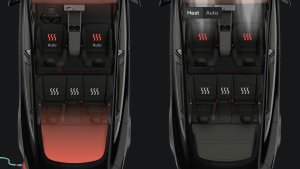
Inside, the central driver seat is flanked by large touchscreens and wrapped in acoustic glass and soundproofing, complete with a heated and ventilated captain’s chair and standing headroom.
Autonomous features are also on the horizon. Tesla confirmed earlier this summer that Full Self-Driving (Supervised) is coming to the Semi, and as the Class 8 electric truck makes its way to Europe, consumer FSD is already making major inroads across the continent. Six EU member nations — most recently Slovenia — have approved FSD for use on their roads, and a vote for bloc-wide approval is set to take place soon.
Initial European units will likely be built in the U.S., at Tesla’s new dedicated Semi factory in Nevada. Tesla is also set to hold a Semi event at this facility soon. Over time, European production is expected to migrate to Gigafactory Berlin, giving European freight corridors an all-electric heavy-duty hauler built locally.