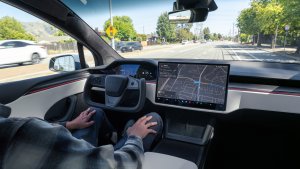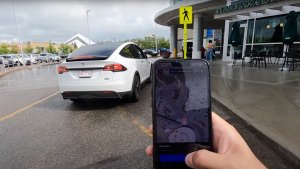
There's an amusing discussion on YouTube, shown below, about what the world might be like when all cars are autonomous.
The chat starts off by mentioning that when all the cars are driven by computers, there's an unintended consequence to excessive safety. How, you might ask, can cars be too safe?
Here's the thought experiment. Imagine a world where all the cars are driven by computers. The computers are never distracted, never in a hurry, never mentally unbalanced and unfailingly polite. So no motor vehicle collisions, right?
Now imagine that there's a pedestrian. He's in the middle of the block on a heavily traveled avenue, and he needs to get to a building directly across the street. He's in a hurry, distracted, mentally balanced and polite most of the time. Imagine this is on Madison Avenue in New York, and there are financial consequences to being late.
Will he jaywalk? Of course he will. In today's world he'd carefully assess the traffic and think twice about safety before jaywalking. In the world where cars always stop for pedestrians, he wouldn't bother to assess the traffic situation. He'd just make a quick check for nearby uniformed police officers. Seeing none, he'd confidently step out into traffic. In fact, even if he weren't in a hurry, he, and everyone else who needed to cross the street would check for cops, not cars, before jaywalking.
Traffic in New York usually runs smoothly on the north south avenues where parking rules are scrupulously enforce, traffic is one way and traffic lights are timed. On the cross streets, mostly narrow with lots of double parking, traffic doesn't move well at all. That's why New Yorkers walk a lot. Traffic would come to a standstill if people could jaywalk on the avenues as long as there was no police presence. It's the fear of getting hit by a car that keeps jaywalking in check. And it's not just in New York. Traffic in every city and town would be slowed to a crawl by a crowd of uncaring jaywalkers.